
Understanding Labour Productivity
Almost half of construction sector companies are facing problems with recruiting skilled workers. We all know that, but do we understand productivity and its impact on the construction sector?
By Ron Coleman
Productivity in the construction activity sits at 48.6%, which is well below the average Canadian rates for all industries combined (63.6%).
According to TD (Bank) Economics in September 2024, “If Canada does not play to win on labour productivity, it risks a continued drop in living standards, worsening wage stagnation, and a deterioration in public services.”
Today, Canada ranks 18th globally on the most common measure of productivity, with its position dropping steadily over the last several years.
Due to a shortage of skilled labour, there is little companies can do to earn more money. One option is to buy a competitor and consolidate the two businesses for greater efficiency and lower overhead. A second option is to increase selling prices to generate more profit from existing labour resources.
The third, and easiest and least expensive, option is to increase productivity.
Raising prices is a no brainer. Add $10 per hour to your charge out rate and with a little luck you will lose some very price sensitive, high maintenance clients. In many trade services, speed and quality of service always rank higher than price. A frozen or corroded pipe waits for no man (or woman). At a productivity rate of 80%, a $10 per hour upcharge this would generate $1,280 per technician per month. With five techs, that equates to additional profit of around $70,000 per year. In 10 years, you could easily have an extra $750,000 in your retirement fund.
Increasing other costs can also get you a better return on labour. Such items as fuel charges, miscellaneous, remembering to charge for using vacuum pumps and many other specialty tools, all add to the bottom line.
Labour productivity
Increasing labour productivity is less about getting your workers to work harder and more about providing better information to your techs so that they can work smarter.
However, most companies have no idea what their productivity rate is. One simple way to calculate it is to first divide the payroll for techs by the number of hours billed in a period. This gives you the average real cost of labour.
This example uses a one-month pay period with five techs improving productivity from 80% to 90%.
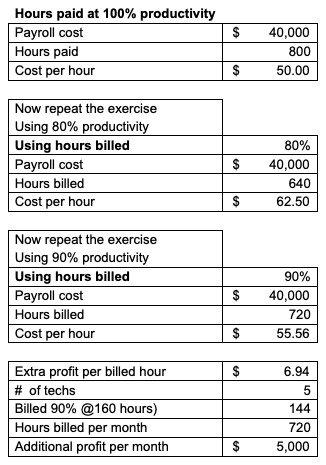
Manage what you can measure.
If you don’t know the answers to the above, there is nothing you can do to make more money and increase the value of your business. The real reason for being in business is to be able to sell it for the best price that allows you to retire in comfort.
If you go through this exercise for a few pay periods you will start to get a better feel for your productivity. Share that with your employees and ask them how they feel the company can improve the level of productivity.
Some very simple answers also come to the fore.
Improving productivity
Reduce travel time between jobs. Major highways are never fun at the best of times, and all big cities in Canada have congestion issues. In Vancouver, there are bridges and tunnels that were never designed to take the current workload. Reduce travel times by bidding jobs in your local area, planning routes to avoid bridges and tunnels, and implementing multi-tasking and efficiency within trips.
Ensure adequate materials and supplies. Before going to a specific job, ensure your techs have a complete list of equipment and materials on hand and at the jobsite. Plan efficiency into your work schedule and prioritize companies offering shorter lead times. Calculate the cost difference between paying for expedited shipping and stalling a job because the materials haven’t arrived on time and plan accordingly.
Prioritize industry knowledge among team members. Well trained techs are extremely valuable. Keep them trained and keep them happy. They are the backbone of your business. Implement a mentoring program and ensure there are experienced and knowledgeable persons available at all times to help provide tech support.
This article is the first in a series of best business practices articles written by Ron Coleman, author and consultant to the construction industry. It has been shared with Ron Coleman’s permission. Learn more about Ron’s work at ronaldcoleman.ca